35+ Family Games for Mixed Age Groups Everyone Can Enjoy
Finding a game that works for a 5-year-old, a teenager, a parent, and a grandparent can be surprisingly difficult. Younger children usually need simple rules, older kids want more challenge, and adults want something that feels genuinely fun rather than overly childish.
The good news is that plenty of family games for mixed age groups can bring everyone to the same table. The best choices are easy to learn, flexible enough for different skill levels, and engaging without making younger players feel left behind.
This guide includes board games, card games, active games, outdoor activities, cooperative challenges, and no-equipment ideas. You will also find suggestions for different ages, group sizes, locations, and family occasions so you can quickly choose something that fits your group.
What Makes a Good Family Game for Mixed Age Groups?

A game does not have to be specifically labeled “for all ages” to work well with a mixed-age family. What matters is how easily the game can accommodate different abilities and attention spans.
Easy-to-Learn Rules
Complicated instructions can quickly cause younger children to lose interest. A good family game should be possible to explain in just a few minutes.
Games such as Uno, Spot It!, charades, and simple scavenger hunts work well because players can understand the basic idea without reading a long rulebook.
Different Skill Levels Can Play Together
A strong mixed-age game allows younger children to participate while giving older players enough challenge to remain interested.
Team-based games are especially useful because a younger child can work alongside an older sibling, parent, or grandparent.
Short and Flexible Playing Time
Families do not always have an entire evening available for one game. Quick games are particularly useful when children have shorter attention spans.
You can also choose games that can be stopped after one round instead of requiring everyone to commit to a long session.
Everyone Gets to Participate
Games are more enjoyable when nobody spends most of the time sitting and watching other people play.
Competitor research also emphasizes whole-group participation and collaborative formats as useful approaches for mixed gatherings.
Simple Setup
The best family games do not require an hour of preparation. A deck of cards, paper and pencils, or a few household objects can be enough to create an entertaining family activity.
35+ Best Family Games for Mixed Age Groups
Here are some of the best options to consider when your family includes several different age groups.
1. Uno
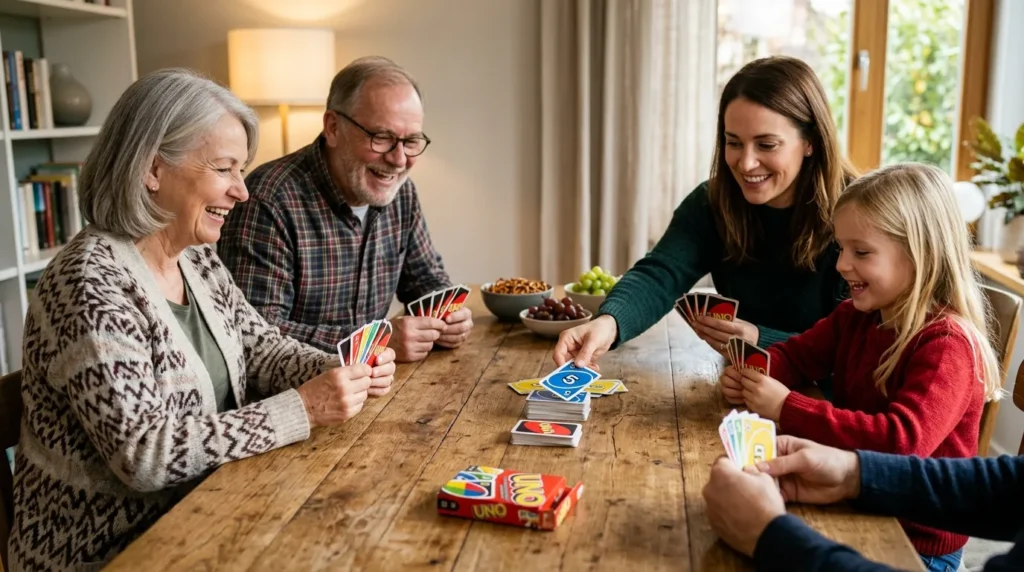
Uno is a classic choice for family game night because the basic matching rules are easy to understand.
Younger children can learn to match colors and numbers, while older players can pay more attention to action cards and strategy. Parents can also help younger children when they are first learning.
Best for: Young children, older kids, teens, and adults
Type: Card game
Setup: Very easy
2. Spot It!
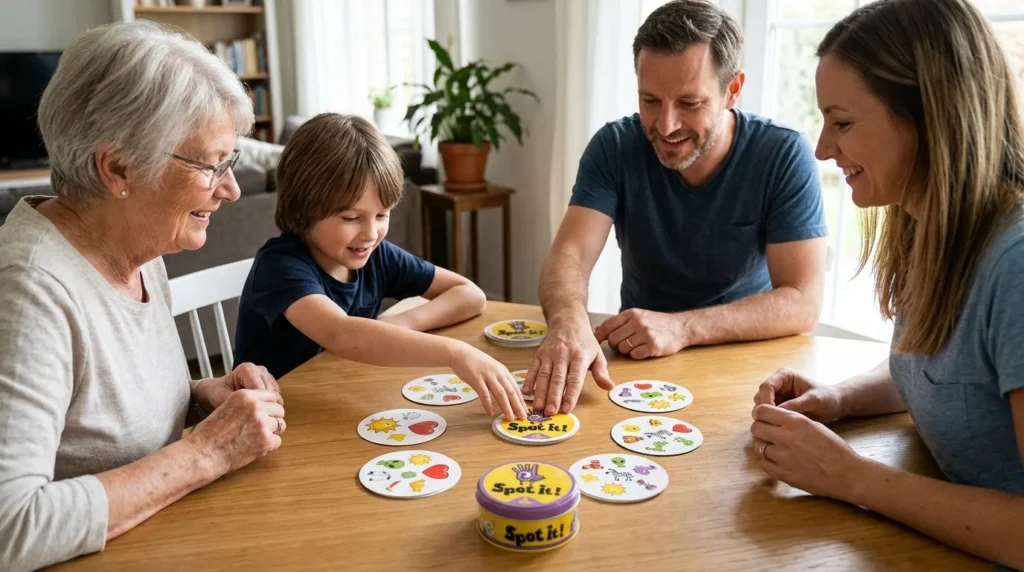
Spot It! is a fast matching game that can work particularly well with younger children. Players look for matching symbols between cards, making the basic concept easy to understand.
Its short rounds also make it useful when you have children who struggle with long games.
Best for: Young children and families
Type: Matching card game
Setup: Very easy
The competitor article specifically notes that Spot It! can be adapted for children as young as 3 and is easy to take with you.
3. Qwirkle
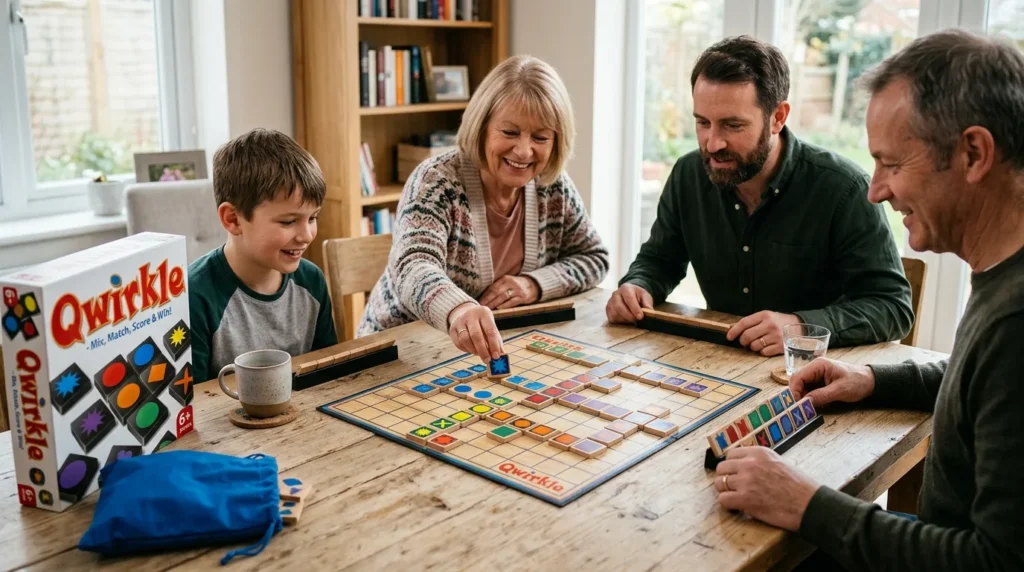
Qwirkle combines colors, shapes, and simple strategy. Younger players can focus on matching while older players can think several moves ahead.
This makes it a useful option when children and adults have different strategic abilities.
Best for: Ages 6 and up
Type: Tile game
Difficulty: Easy to moderate
4. Sushi Go
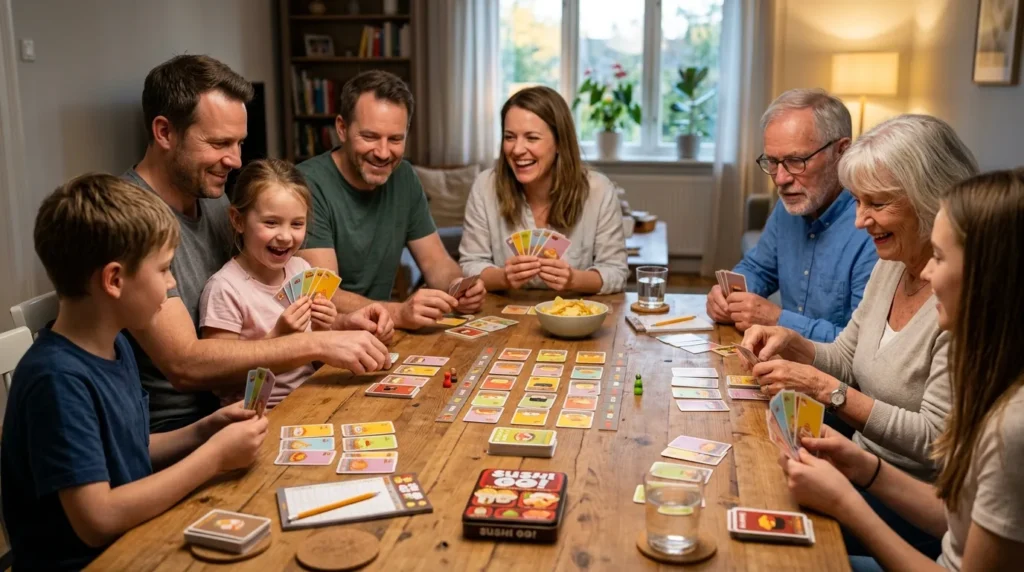
Sushi Go is a quick card game that does not require a long time commitment.
Players collect cards and try to create combinations that earn points. Because rounds are relatively short, families can easily fit in a game between dinner and another activity.
The competitor source describes it as a quick game that can work when a family has only about 15 minutes available.
5. Telestrations
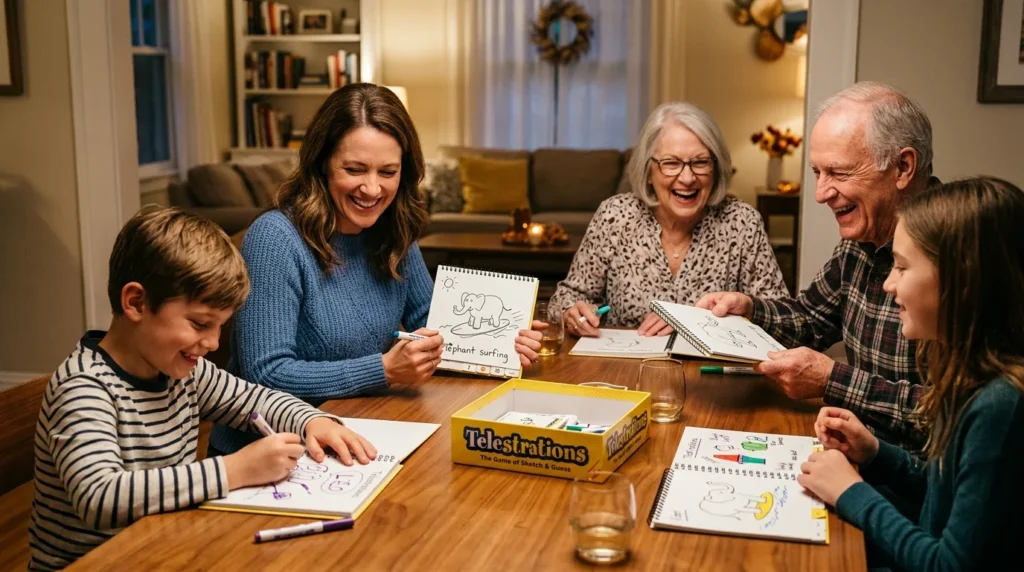
Telestrations combines drawing and guessing, which makes it more about laughter than complicated strategy.
Younger players can receive easier words while older children and adults can handle more challenging prompts.
Best for: Older children, teens, and adults
Type: Drawing and guessing game
Difficulty: Easy
6. HeadBandz
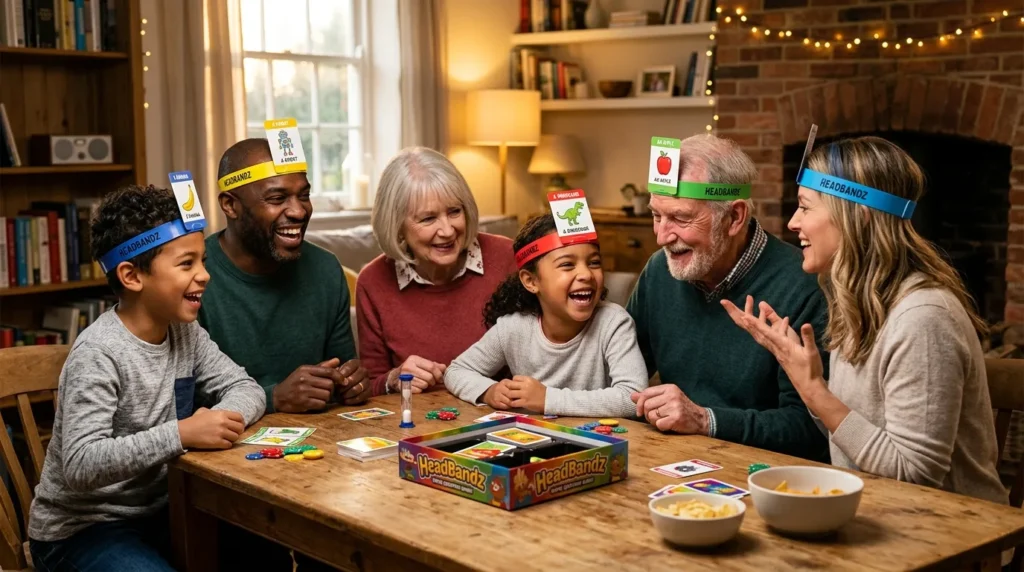
HeadBandz is a simple guessing game where players try to figure out what is shown on their card by asking yes-or-no questions.
The straightforward format allows younger children to participate with help from older family members.
Best for: Young children and families
Type: Guessing game
Difficulty: Easy
The competitor source identifies HeadBandz as playable by children from around age 3 and notes that it can be enjoyed by a wide range of ages.
7. Taco Cat Goat Cheese Pizza

This fast-paced game uses matching, quick reactions, and repeated words. It is especially entertaining for families that prefer energetic games.
Because the basic rules are simple, children can get involved without needing advanced reading or strategy skills.
Best for: Young children through adults
Type: Fast card game
Difficulty: Easy
8. Skyjo
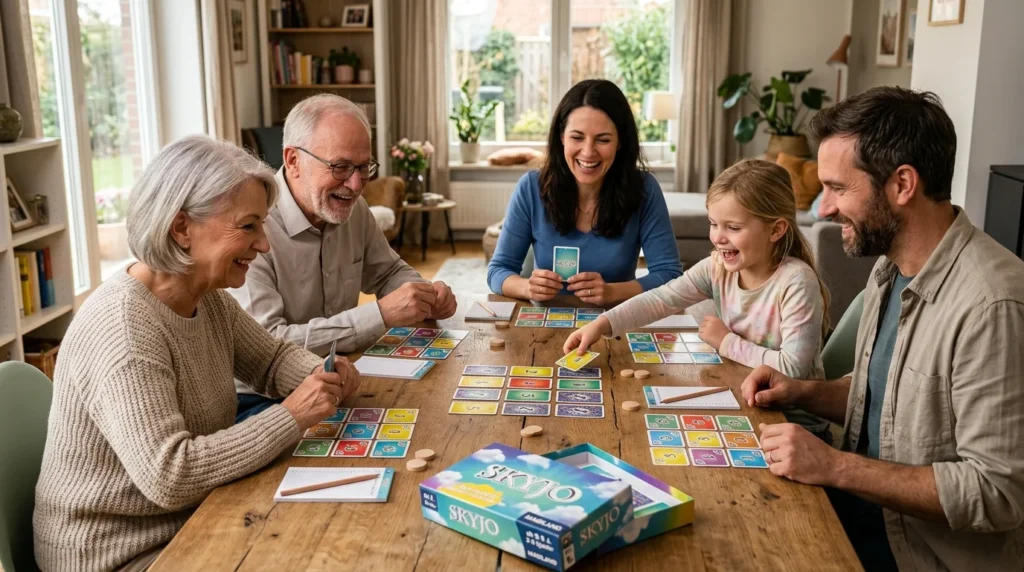
Skyjo is a useful choice for families that want a relatively calm card game.
Players try to achieve a low score, and younger children can receive assistance from adults while learning how the game works.
The competitor source specifically highlights the game’s accessibility and the ability for players to help younger children.
9. Sleeping Queens
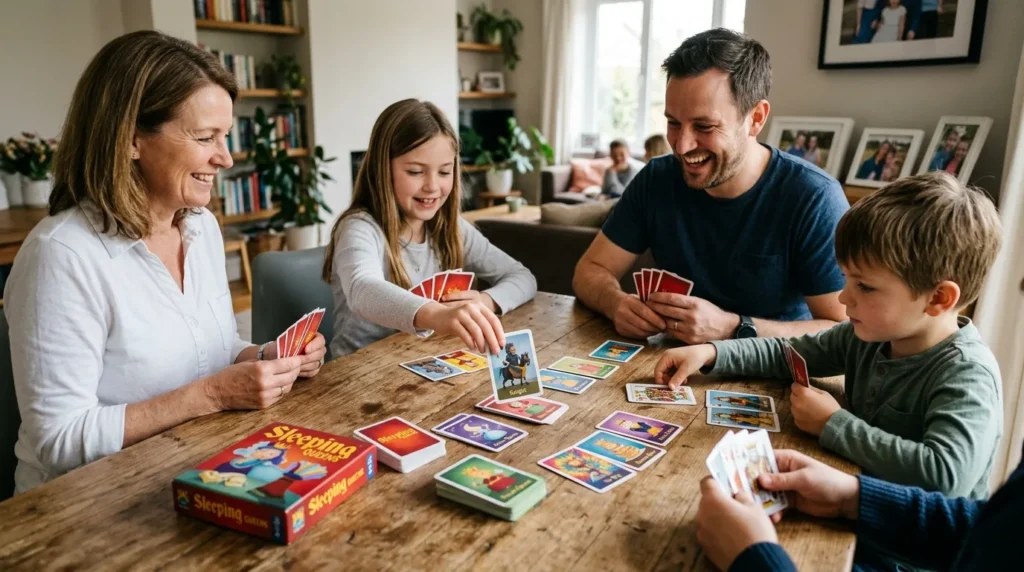
Sleeping Queens can be a good bridge between games designed for young children and games that adults can also enjoy.
Its simple gameplay makes it approachable for younger players while still giving older family members something to think about.
Best for: Younger children and families
Type: Card game
10. Ticket to Ride
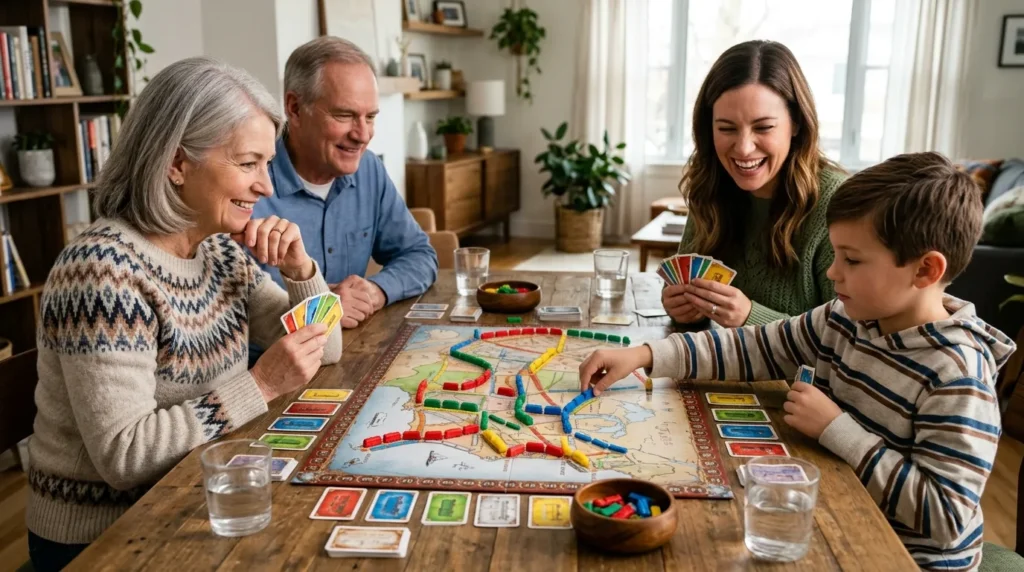
Ticket to Ride is better suited to families with older children, teens, and adults.
Players build train routes and make decisions about how to connect destinations. Younger children may need assistance, but that can turn the game into a cooperative family activity.
The competitor source recommends it for children around 8 and up.
11. Scattergories
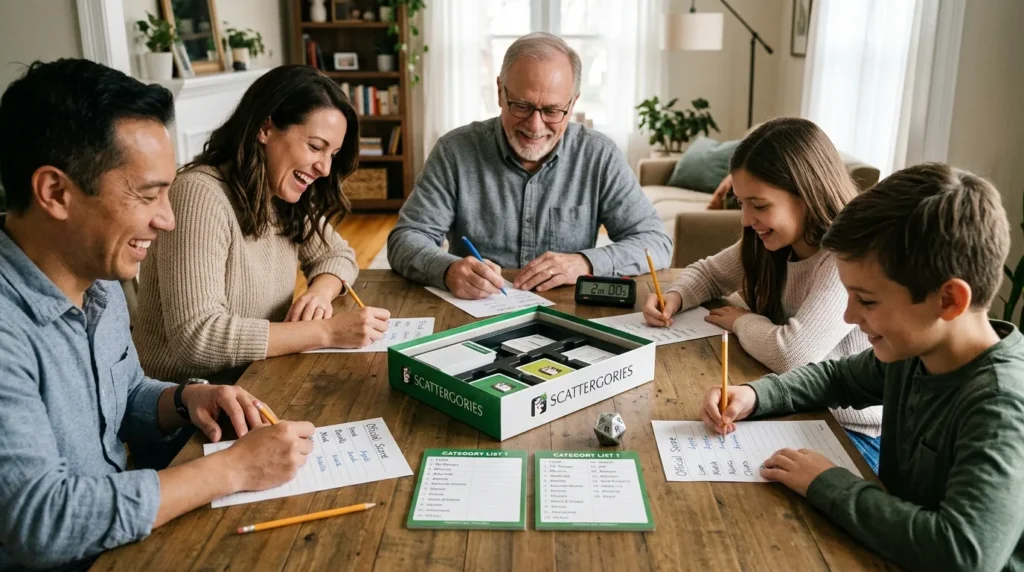
Scattergories is a good option when your group includes older children and adults who enjoy word-based challenges.
To make it easier for younger players, choose simple categories and allow extra time.
Best for: Older children, teens, and adults
Type: Word game
12. Five Crowns
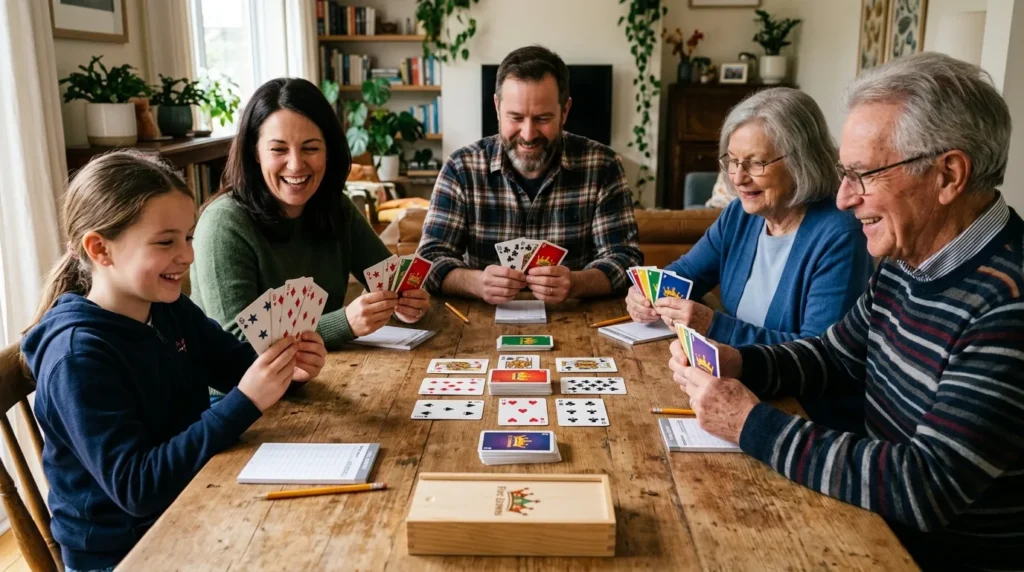
Five Crowns is a card game that can work particularly well with extended families.
Older players can handle the strategy independently, while younger children can receive guidance when necessary.
Best for: Older children and adults
Type: Card game
The competitor source also notes that it can work with larger groups and can be adapted to younger players with assistance.
13. Code Names
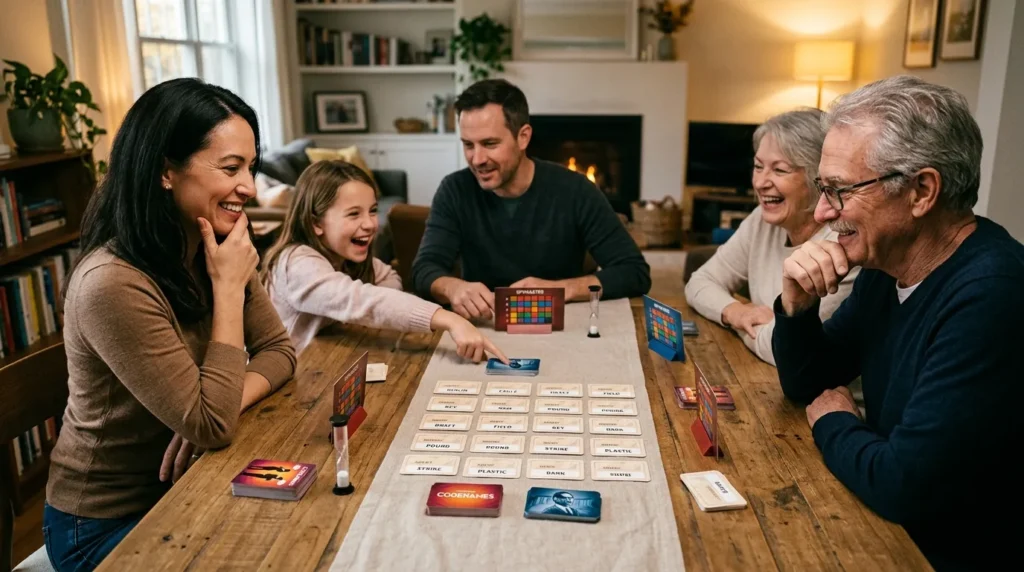
Code Names is a word association game that works especially well with older children, teens, and adults.
For mixed-age groups, divide everyone into teams rather than having children compete individually against adults.
The competitor source describes it as more appropriate for older children while noting a picture-based version that may be easier.
14. It’s in the Bag
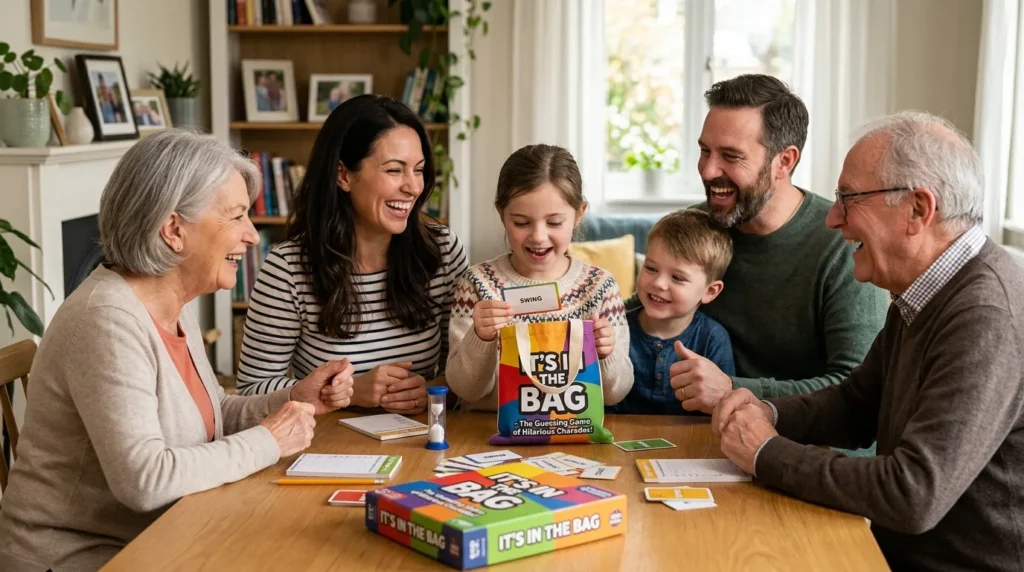
It’s in the Bag combines word guessing and charades, making it a lively group game.
It can be especially fun when you have several generations together because players can use humor and creativity rather than relying entirely on knowledge.
Best for: Older children, teens, and adults
Type: Party game
15. Monopoly Deal

Traditional Monopoly can take a long time, which is not always ideal for families with young children.
Monopoly Deal offers a shorter card-game format that can fit more easily into a family game night.
The competitor source describes it as a simplified Monopoly-style game that can be played in a much shorter session.
16. Happy Salmon
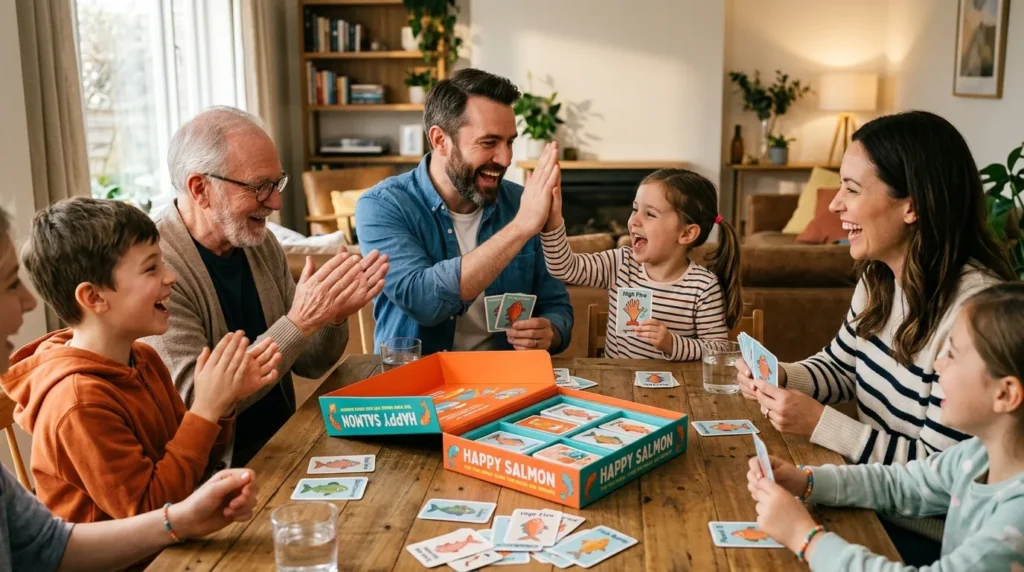
Happy Salmon is a highly active group game involving movement and matching.
It is a good choice when everyone needs to get up from the table and move around.
Best for: Children and families who enjoy active play
Type: Active card game
17. Charades
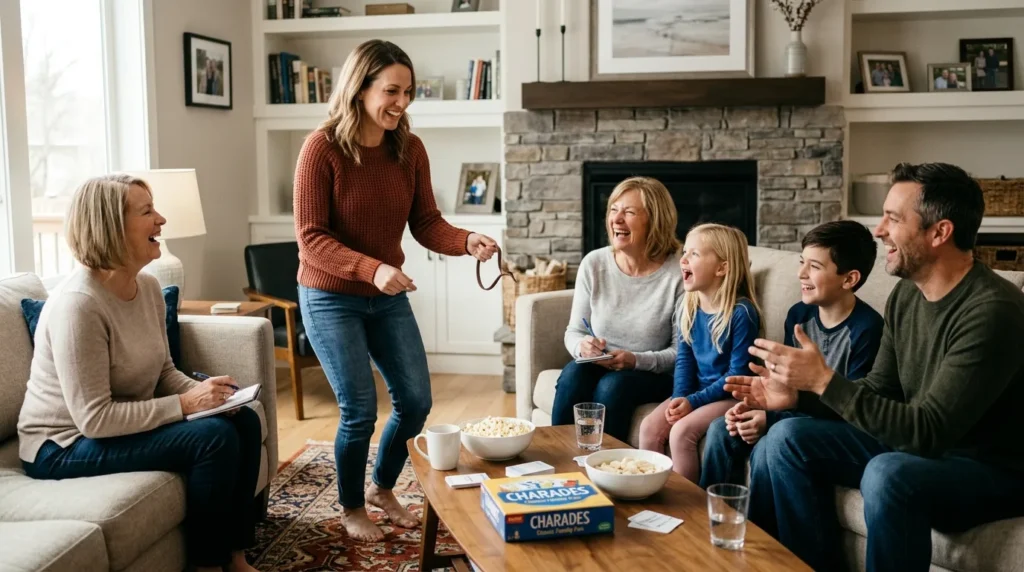
Charades is one of the easiest mixed-age games because you can change the difficulty of the prompts.
Young children can act out animals, foods, or simple actions. Older children and adults can receive movies, occupations, books, or more complicated concepts.
No expensive equipment is necessary.
18. Pictionary
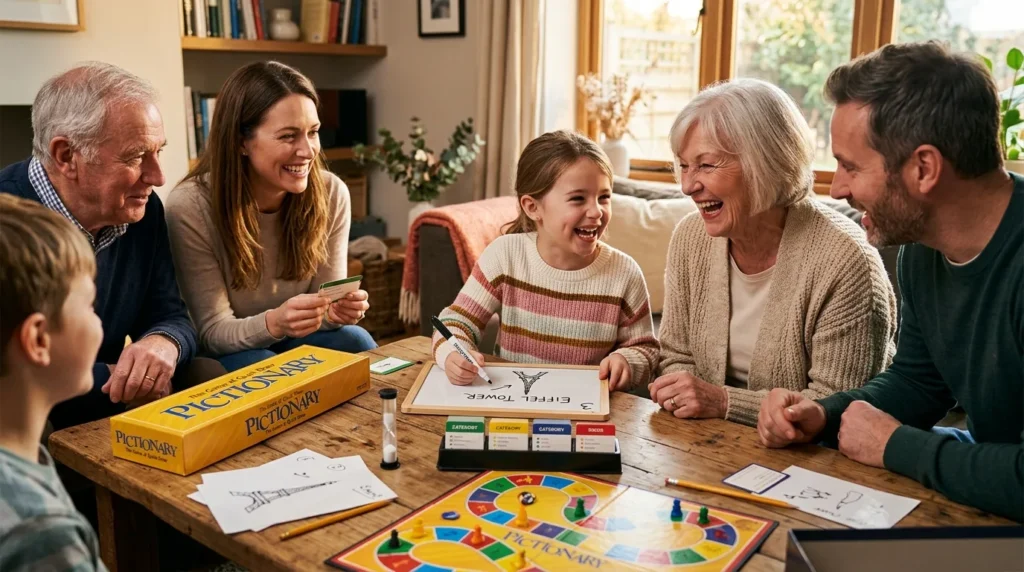
Pictionary works in much the same way.
Give younger children simple objects to draw and older players more difficult prompts. Putting different ages on the same team can make the game more balanced.
19. Family Trivia
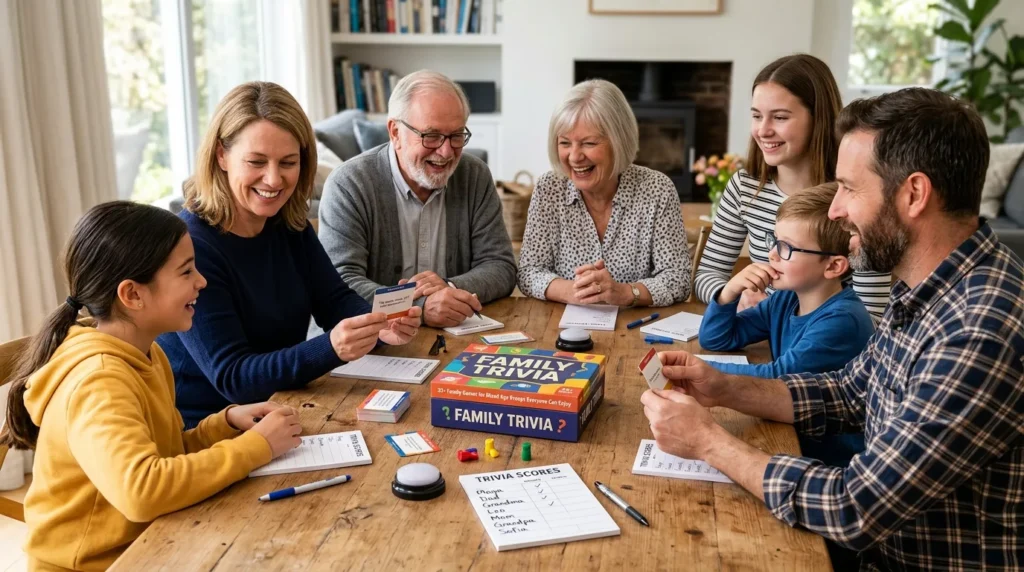
Family trivia can be customized for the people playing.
Instead of asking every player the same difficult questions, create rounds for different age groups. You can also give bonus points for questions answered by younger family members.
20. Scavenger Hunt

A scavenger hunt is excellent for mixed-age groups because everyone can contribute differently.
Adults can read clues, older children can solve puzzles, and younger children can search for objects.
Mixed-age teams can be particularly effective because different players bring different abilities.
21. Treasure Hunt
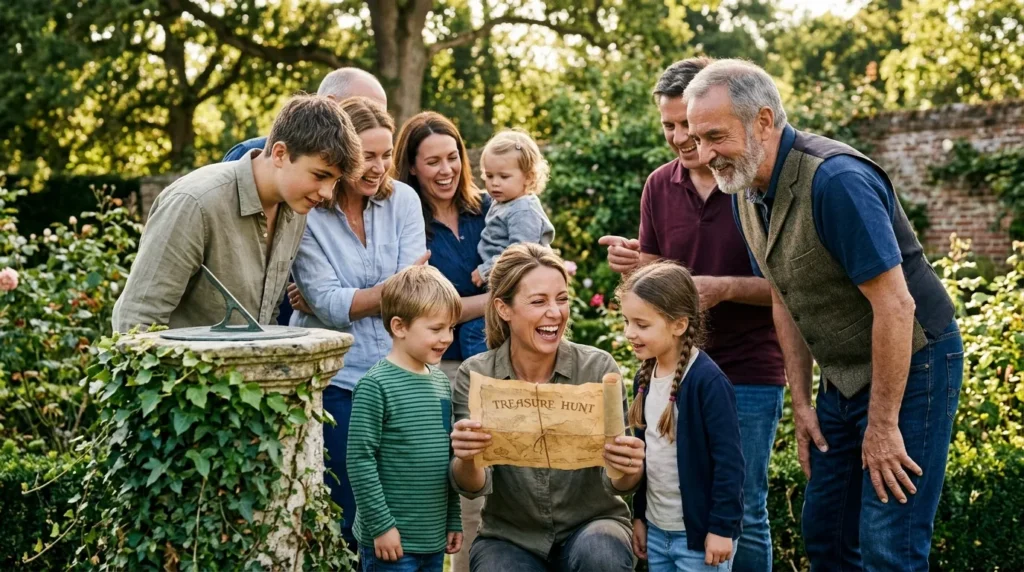
A treasure hunt is another flexible option.
For younger children, hide obvious objects in safe locations. For older children, create written clues, riddles, or a sequence of challenges.
You can run the activity indoors, in a backyard, or throughout a larger outdoor space.
22. Simon Says

Simon Says requires almost no equipment and can be adapted for nearly any group.
Younger children can follow simple instructions, while older children can take turns being the leader.
23. Freeze Dance

Play music and ask everyone to dance. Stop the music at random moments, and everyone freezes.
You can make it competitive or simply play for laughs.
Competitor 1 identifies freeze dance as an inexpensive activity that works across age groups and requires very little equipment.
24. Musical Statues

Musical statues follows a similar concept but can be played with different rules depending on the age of the group.
For younger children, avoid elimination and simply have everyone freeze whenever the music stops.
25. Two Truths and a Lie
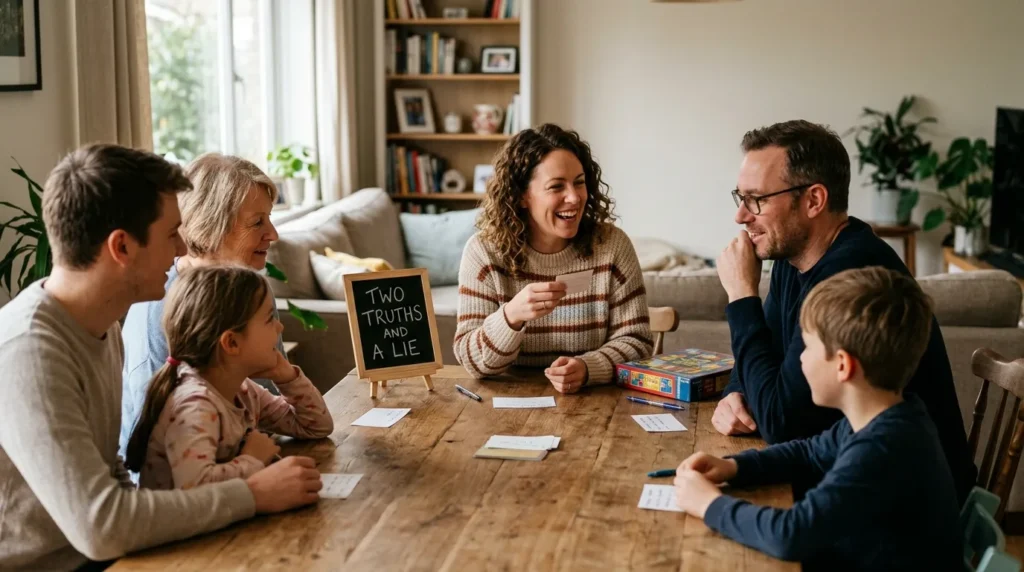
This game is particularly good for older children, teenagers, and adults.
Each person says three statements about themselves, with one being false. Everyone else tries to identify the false statement.
It can be a fun way for family members to discover stories they did not already know about one another.
26. Name Game
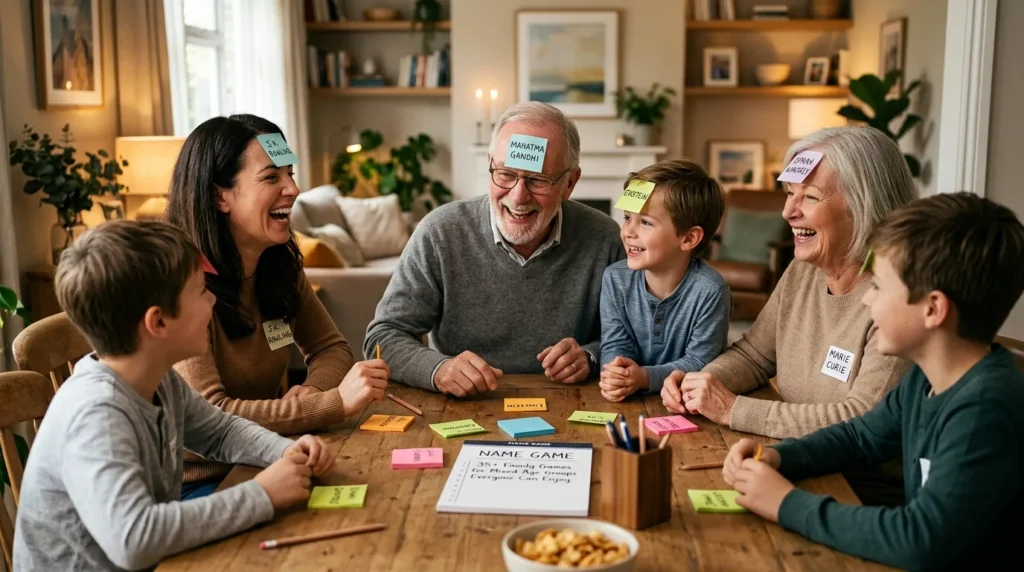
Sit in a circle and have each person say their name with an action. The next player repeats the previous names and actions before adding their own.
Younger children can perform simple movements while older players try to remember the growing sequence.
27. Balloon Toss

Balloon toss is an excellent outdoor activity for a warm day.
Pairs toss a balloon or water-filled balloon back and forth, moving farther apart after successful catches.
The activity can be made less competitive for younger children by allowing them to stand closer together.
28. Relay Race

Create teams containing different ages instead of separating adults and children.
You can include simple activities such as running, balancing an object, carrying a ball, or completing a short obstacle.
The goal does not have to be speed. Mixed-age teams can focus on completing the course together.
29. Obstacle Course
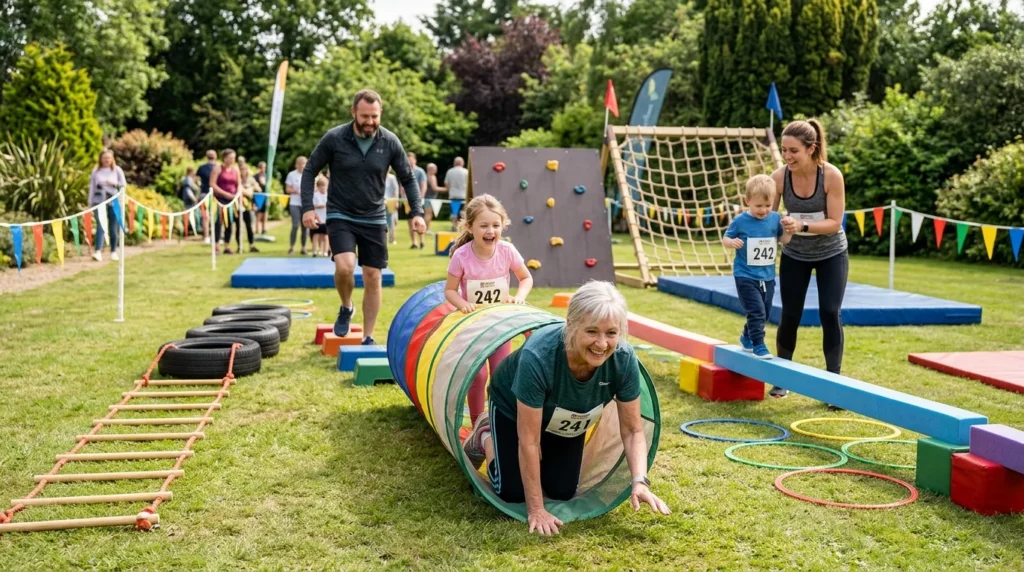
Create an obstacle course using household or backyard objects.
Younger children can have a simpler route, while older players can complete additional challenges.
Competitor 1 suggests using accessible items such as hoops and cones to create different sections of an outdoor course.
30. Tug of War

Tug of war can be exciting for large family gatherings.
For mixed ages, consider creating balanced teams instead of placing all adults on one side and children on the other.
Always choose an appropriate location and equipment, and make safety the priority.
31. Family Bingo
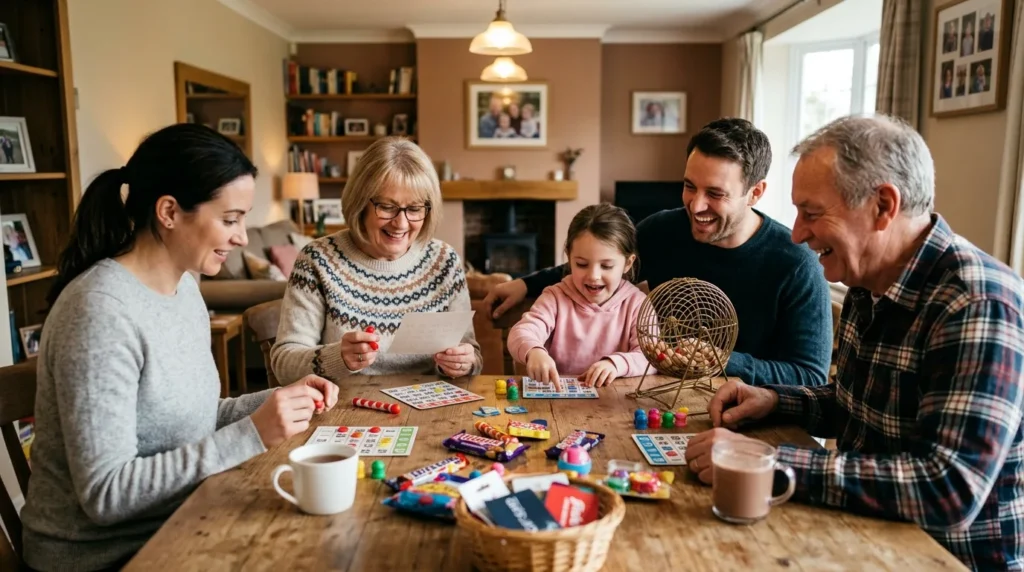
Create bingo cards using numbers, pictures, family facts, or simple objects.
Picture-based cards can help younger children participate while adults and older children enjoy more challenging versions.
32. Memory Game
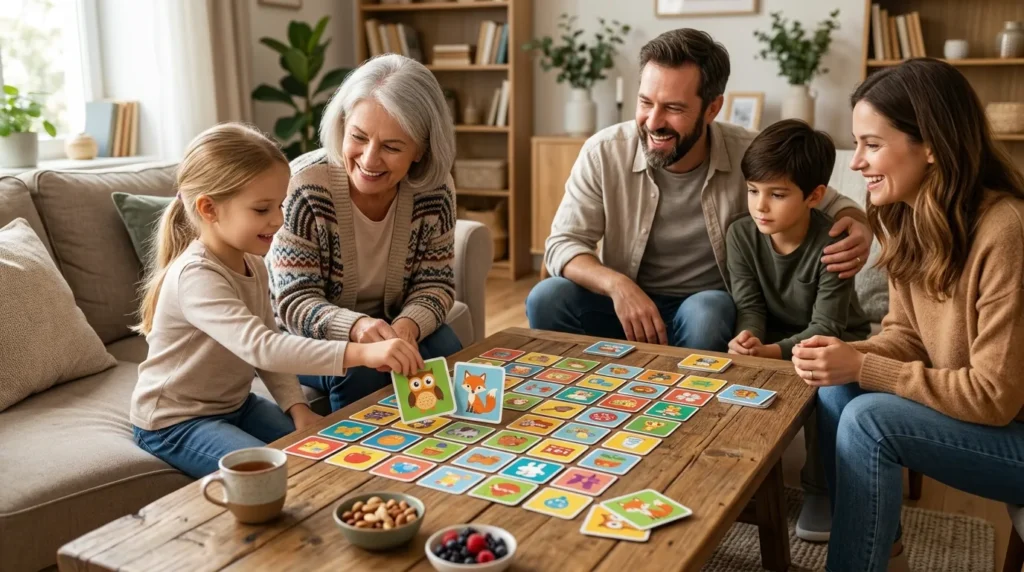
Memory games are particularly useful when younger children are involved.
Start with fewer cards for preschoolers and increase the number as players become more experienced.
You can also use family photographs instead of commercial cards to make the game more personal.
33. Would You Rather?
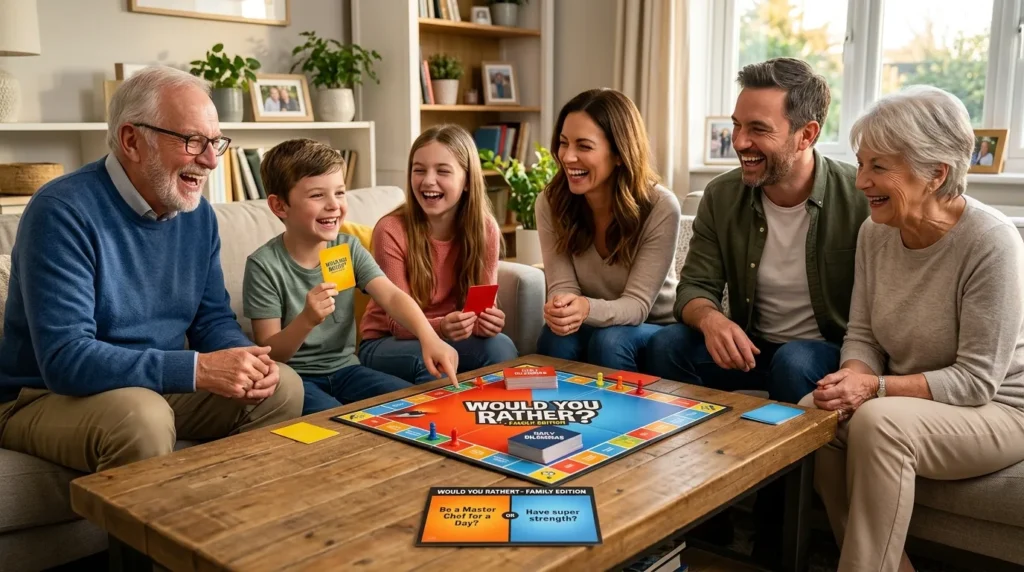
Would You Rather requires no equipment.
Prepare age-appropriate questions and let everyone explain their choice. Younger children can answer simple questions while teens and adults can discuss more creative scenarios.
34. Minute-to-Win-It Challenges
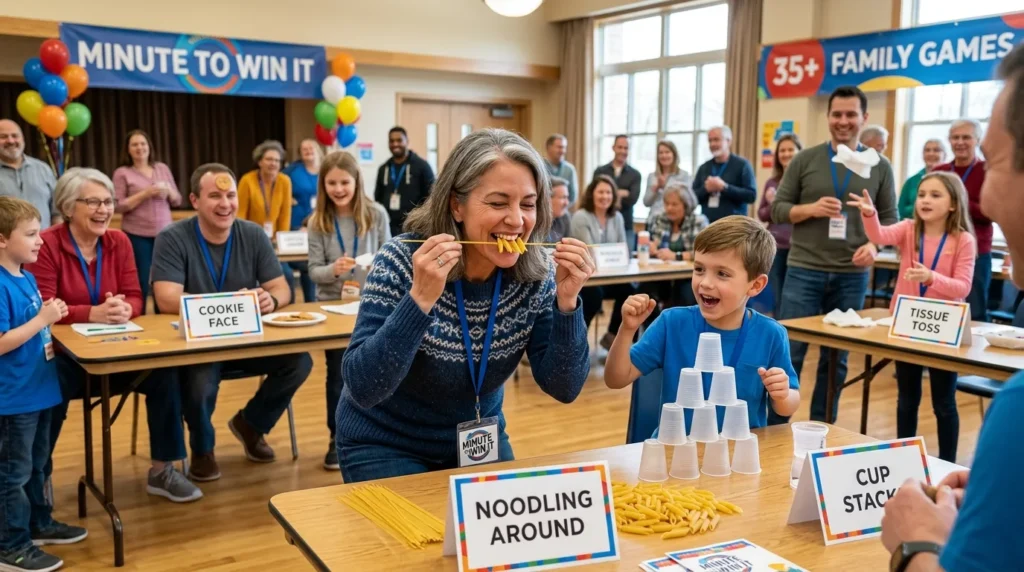
Short challenges are useful when your family has different attention spans.
Each challenge can last only a minute, so players get frequent opportunities to participate.
Examples include stacking cups, moving objects with a spoon, or transferring lightweight items from one container to another.
35. Family Drawing Challenge

Give everyone the same drawing prompt.
Younger children can interpret it freely while older players can try to create more detailed drawings.
At the end, everyone can explain their creation rather than judging based purely on artistic ability.
36. Storytelling Game
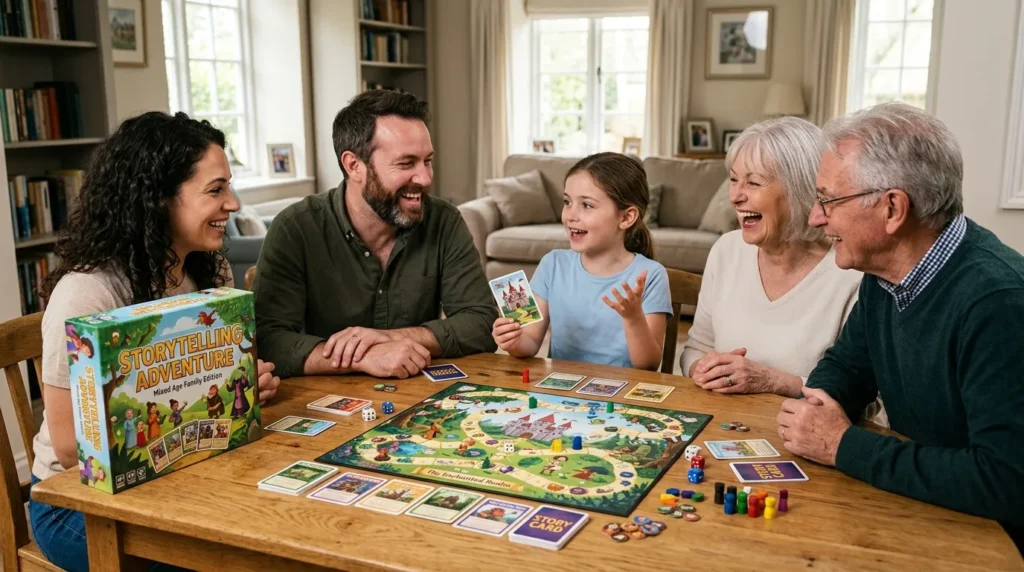
Start a story with one sentence.
Each person adds another sentence until the family has created a complete story.
Young children can contribute simple ideas while older players can introduce twists and characters.
37. Guess the Song
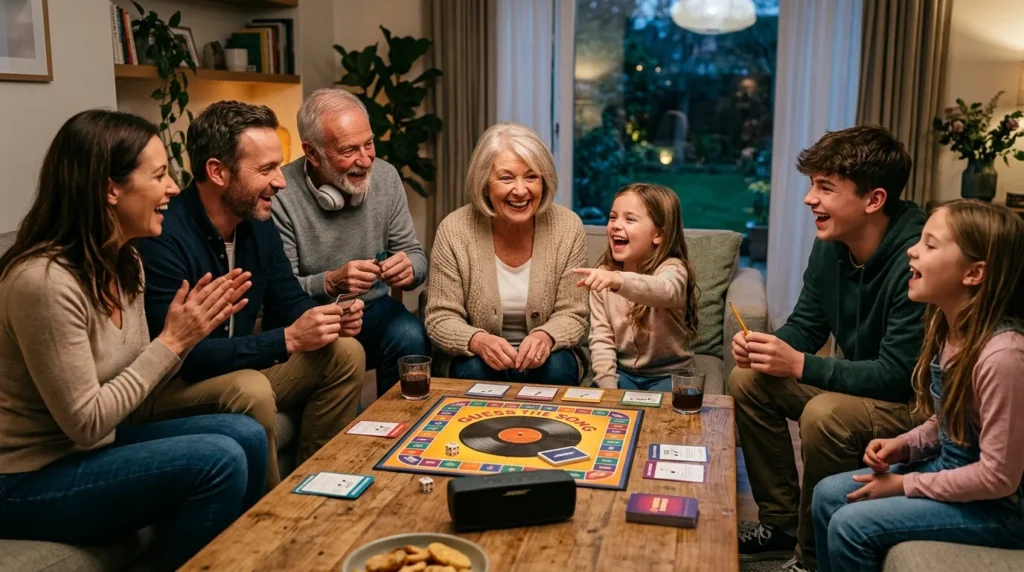
Choose songs from different generations.
Play a short section and have teams guess the song or artist. To make it fair, create rounds representing different age groups.
This can turn generational differences into part of the fun.
38. Family Charades
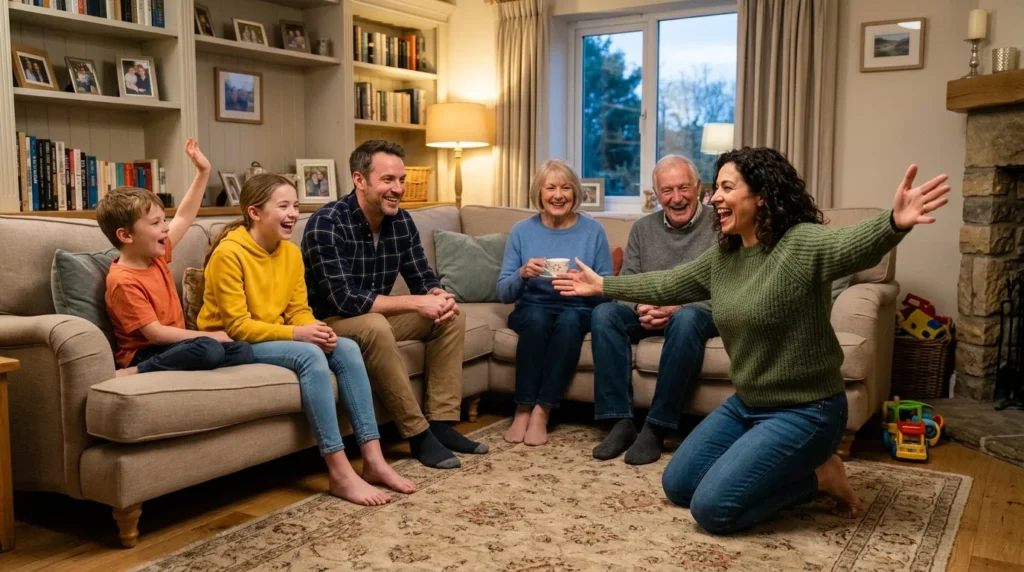
Create three levels of prompts:
Easy: Animals, foods, sports, actions
Medium: Jobs, places, hobbies, activities
Hard: Movies, books, famous fictional characters, complex situations
This makes one game suitable for a much wider age range.
39. Family Quiz Night
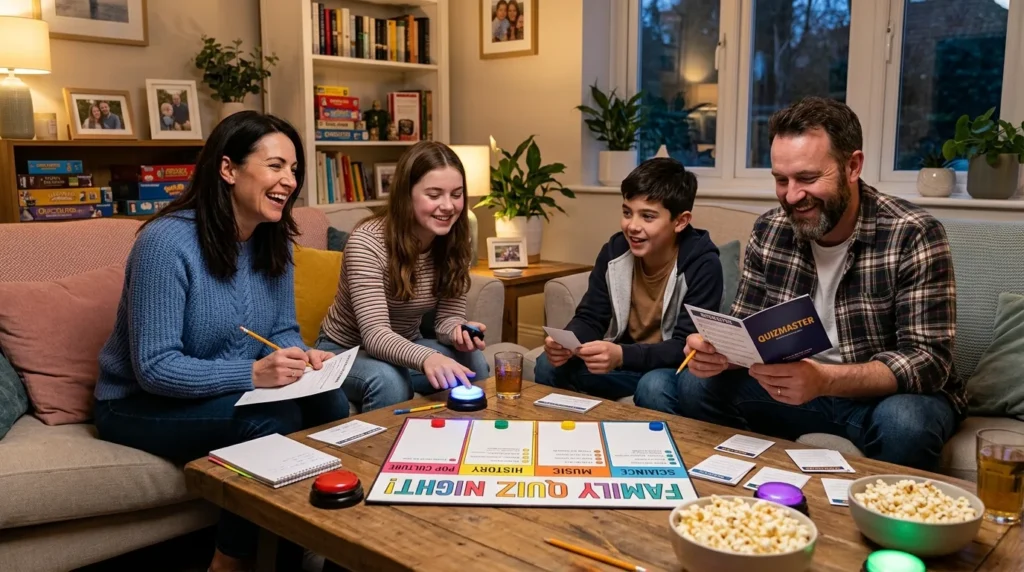
Create mixed-age teams and combine questions from several categories.
Include children’s questions, general knowledge, music, movies, sports, history, food, and family trivia.
A mixed team structure prevents the game from becoming a competition between generations.
Best Family Games by Age Group
Different ages have different needs, so choosing the right activity becomes easier when you start with the youngest person playing.
Best Games for Ages 3 to 5
For preschoolers, prioritize simple rules and short sessions.
Good choices include:
- Memory games
- Simon Says
- Freeze Dance
- HeadBandz
- Spot It!
- Simple treasure hunts
- Picture bingo
The goal is participation rather than complicated strategy.
Best Games for Ages 6 to 8
Children in this range can usually handle more structured games.
Try:
- Uno
- Qwirkle
- Sushi Go
- Skyjo
- Taco Cat Goat Cheese Pizza
- Treasure hunts
- Charades
- Simple trivia
Best Games for Ages 9 to 12
Older children can usually handle more complex rules and strategy.
Consider:
- Telestrations
- Ticket to Ride
- Code Names
- Five Crowns
- Pictionary
- Family trivia
- Scavenger hunts
Best Games for Teens and Adults
When teenagers and adults make up most of the group, consider:
- Scattergories
- Code Names
- Two Truths and a Lie
- Telestrations
- Charades
- Trivia
- Five Crowns
- Ticket to Ride
Best Family Games for Kids and Adults to Play Together
The trick to getting kids and adults to enjoy the same game is avoiding a situation where one age group has an overwhelming advantage.
Team games can solve this problem.
For example, put one adult, one teenager, and one younger child on each team. The adult can help explain rules, the teenager can contribute strategy, and the younger child can participate in the simpler parts.
Games where everyone participates at the same time can also work better than games where one person performs while everyone else waits.
Best Cooperative Family Games for Mixed Ages
Cooperative games can be particularly useful when younger children become frustrated by losing.
Instead of competing against one another, the family works toward a shared goal.
Try:
- Cooperative card games
- Team scavenger hunts
- Family treasure hunts
- Group storytelling
- Team trivia
- Collaborative drawing
- Group obstacle courses
The Crew, for example, is described by the competitor source as a cooperative card game in which players work toward a shared outcome.
Best Indoor Family Games for Mixed Age Groups
Indoor games are useful for rainy days, family game nights, holidays, and smaller living spaces.
No-Equipment Indoor Games
- Charades
- Simon Says
- Storytelling
- Two Truths and a Lie
- Would You Rather
- Family trivia
- Freeze dance
Card and Board Games
- Uno
- Spot It!
- Qwirkle
- Sushi Go
- Skyjo
- Telestrations
- Ticket to Ride
Best Outdoor Family Games for Mixed Age Groups
Outdoor activities give families more room to move.
Try:
- Scavenger hunts
- Treasure hunts
- Relay races
- Balloon toss
- Obstacle courses
- Tug of war
- Outdoor trivia
- Freeze dance
Outdoor games should always be matched to the location, weather, equipment, and ages of the participants. Competitor 1 also recommends checking the play area for hazards and making water and shaded rest areas available.
Best No-Equipment Family Games
If you do not have board games available, you still have plenty of choices.
Try:
- Charades
- Simon Says
- Freeze Dance
- Storytelling
- Two Truths and a Lie
- Name Game
- I Spy
- Would You Rather
- Family trivia
- Guess the Song
These options are particularly useful when traveling or when relatives arrive unexpectedly.
How to Choose a Family Game When Everyone Is a Different Age
Start by considering the youngest player.
If the youngest participant cannot understand the rules or participate independently, the game may quickly become frustrating.
Next, think about the oldest children and adults. If the game is too simple, they may lose interest.
A good compromise is to choose a simple game with optional strategy or adjustable difficulty.
Also consider:
- Number of players
- Available space
- Available time
- Reading ability
- Attention spans
- Physical abilities
- Competitive versus cooperative preferences
- Amount of equipment required
How to Make One Game Work for Multiple Ages
You do not always need a different game for every age group.
Create Mixed-Age Teams
Pair younger players with older children or adults.
Adjust the Rules
Give younger players fewer cards, simpler questions, or extra time.
Use Different Difficulty Levels
For trivia, create easy, medium, and challenging questions.
Avoid Early Elimination
If a young child gets eliminated after five minutes, they may spend the rest of the game watching.
Instead, allow eliminated players to rejoin after a round or remove elimination altogether.
Give Everyone a Role
A younger child might search for objects while an older child reads clues. An adult can keep track of points.
This makes everyone feel useful.
Family Games for Large Groups
Large families need games that can accommodate many people without creating long waiting periods.
Good choices include:
- Scavenger hunts
- Team trivia
- Charades
- Pictionary
- Relay races
- Family bingo
- Outdoor obstacle courses
- Group storytelling
For large groups, teams are often easier to manage than individual competition.
Family Games for Different Occasions
Family Game Night
Choose a combination of one quick game, one longer game, and one active game.
Family Reunions
Choose activities that allow large groups to participate, such as scavenger hunts, trivia, charades, and relay races.
Birthday Parties
Younger children often enjoy treasure hunts, musical statues, freeze dance, and simple active games.
Holiday Gatherings
Try family trivia, Guess the Song, charades, bingo, and storytelling games.
Rainy Days
Card games, drawing games, word games, and board games are ideal when everyone is stuck indoors.
Family Vacations
Choose compact games that require little equipment, such as Uno, Spot It!, storytelling, and Would You Rather.
Quick Family Games for 15 to 30 Minutes
When time is limited, choose games that can be completed quickly.
Good options include:
- Uno
- Sushi Go
- Spot It!
- Taco Cat Goat Cheese Pizza
- Charades
- Family trivia
- Memory
- Guess the Song
Short games are particularly helpful when younger children are involved because they allow everyone to finish before attention starts to disappear.
Tips for Keeping Younger Kids Interested
Younger children usually do better when games move quickly.
Keep turns short and avoid lengthy explanations.
Let them team up with an adult when a game is more complicated. You can also give them easier questions or simpler tasks.
Another useful strategy is to alternate energetic activities with quieter games. This keeps the family from becoming overly tired or overstimulated during a long gathering.
Common Mistakes When Choosing Mixed-Age Family Games
Choosing a Game That Is Too Difficult
If children cannot understand what they are supposed to do, frustration can replace fun.
Making Children Compete Directly Against Adults
Adults naturally have more experience with many games. Mixed-age teams can make competition more balanced.
Eliminating Players Too Early
Nobody enjoys sitting out for most of the activity.
Choosing Games That Take Too Long
A game that takes two hours may not work well for younger children.
Ignoring Group Size
A game designed for four players may become frustrating with fifteen people.
Trying to Schedule Too Many Activities
A family gathering does not need to be packed with nonstop games. Competitor 1 similarly emphasizes leaving room for free play and conversation rather than over-scheduling every minute.
Quick Comparison of Family Games for Mixed Ages
| Game | Best Age | Game Type | Difficulty | Best Setting |
|---|---|---|---|---|
| Uno | 5+ | Card | Easy | Indoor |
| Spot It! | 3+ | Matching | Easy | Indoor |
| Qwirkle | 6+ | Tile | Easy to Moderate | Indoor |
| Sushi Go | 5+ | Card | Easy | Indoor |
| Telestrations | 8+ | Drawing | Easy | Indoor |
| HeadBandz | 3+ | Guessing | Easy | Indoor |
| Charades | 5+ | Active | Easy | Indoor/Outdoor |
| Scavenger Hunt | 4+ | Search | Easy | Indoor/Outdoor |
| Freeze Dance | 3+ | Active | Easy | Indoor/Outdoor |
| Pictionary | 6+ | Drawing | Easy | Indoor |
| Family Trivia | 6+ | Questions | Adjustable | Indoor |
| Relay Race | 5+ | Active | Adjustable | Outdoor |
| Obstacle Course | 5+ | Active | Adjustable | Outdoor |
| Guess the Song | 6+ | Music | Adjustable | Indoor |
| Storytelling | 4+ | Creative | Easy | Indoor |
Frequently Asked Questions
What are the best family games for mixed age groups?
Games such as Uno, Spot It!, Qwirkle, charades, scavenger hunts, family trivia, Pictionary, and drawing games can work well because their difficulty can be adjusted for different players.
What games can kids and adults play together?
Charades, Pictionary, scavenger hunts, trivia, Uno, Telestrations, and team-based games are good options for children and adults playing together.
What is a good game for a family with toddlers and older kids?
Choose simple games with flexible rules, such as Memory, Spot It!, Simon Says, HeadBandz, treasure hunts, or team-based activities where an older child can help a younger one.
What family games work for large groups?
Scavenger hunts, charades, trivia, relay races, bingo, Pictionary, and team challenges are useful for larger groups because multiple people can participate at once.
What are the best family games without equipment?
Charades, Simon Says, storytelling, Would You Rather, Two Truths and a Lie, trivia, Guess the Song, and Freeze Dance require little or no special equipment.
What are the best cooperative games for families?
Team scavenger hunts, cooperative card or board games, group storytelling, team trivia, and collaborative challenges allow family members to work toward a shared goal.
How do you make games fair for different ages?
Use mixed-age teams, simplify tasks for younger children, create different difficulty levels, give younger players extra time when appropriate, and avoid eliminating children too early.
What are the best indoor family games for mixed ages?
Uno, Spot It!, Qwirkle, Sushi Go, Telestrations, charades, Pictionary, Memory, family trivia, and storytelling are all useful indoor options.
What are the best outdoor family games for mixed age groups?
Scavenger hunts, treasure hunts, relay races, balloon toss, obstacle courses, tug of war, and outdoor trivia can work well when the space and conditions are suitable.
Final Thoughts
The best family games for mixed age groups are not necessarily the most complicated or expensive ones. They are the games that allow different generations to participate, laugh, cooperate, and enjoy time together.
When choosing a game, think about the youngest player first, then consider the interests of older children and adults. Look for simple rules, flexible difficulty, short playing times, and opportunities for everyone to participate.
For a family with several generations, games such as Uno, Spot It!, charades, scavenger hunts, Pictionary, family trivia, and team challenges can provide an easy starting point. You can then adapt the rules, teams, questions, and difficulty level to suit your particular family.
Most importantly, do not worry about making every minute competitive. Sometimes the best family game is the one that creates the most laughter and gives everyone a reason to sit, play, and enjoy being together.